Thursday, April 17, 2014

Lizards in Pictures: A Letter for Keller

Lizard in Rio Rancho, New Mexico. Photo by Darla Sue Dollman. This little fella lives beneath our rock wall. He is so small he just slides into cracks and disappears when the big birds come near so they won't eat him.

This is a lizard letter for my grandson, Keller Elway, from Mam Mam. Your mommy told me you like lizards. Well, Mam Mam loves lizards, too, and here's a few  pictures of her favorite lizards that she wants to share with you...


This is a funny story you might like to hear! I was walking to the park with your cousins, Layla and Eli Lou, and I told them that I wished they could visit Texas, where you live with your mommy and daddy, or New Mexico, where I live now, so they could see lizards, and while we were talking and walking down the sidewalk I looked at the sidewalk in front of us then stopped walking and said, "Oh my goodness! I think that is a lizard on the sidewalk!" So we walked up to it very slowly and it held still for a long time so I could take pictures.


So, I took his picture, and he moved around a bit and I took more pictures. He watched us watching him and held very still. Then after awhile I think he became bored and walked away. 


This lizard looks like a dinosaur, but he is just a different kind of lizard. He was lying in the sun working on his suntan in Texas. Mam Mam used to live in Texas when you were a baby. We had lots of lizards around our house and birds called Road Runners that liked to eat them. 

'

This is a Road Runner at my house in New Mexico. He likes my house because we have so many lizards and small birds. Road Runners are the fastest birds I've ever seen, but lizards are pretty fast, too! This Road Runner is young and still learning how to hunt. 


This is the lizard in Colorado again! My goodness he likes to have his picture taken! He just keeps popping in here, showing off! I think he must like us. 


This is a lizard sitting on a block of granite in Texas. Granite is a type of pink stone that is all over the part of Texas where Mam Mam used to live called The Hill Country.  Lizards like to lie on rocks in the sunshine to keep their bellies warm. They are fast, but they're kind of lazy, too, sometimes. Sometimes they like to just lie around and watch things. 


These are my neighbors. I did not show their faces because I did not ask their mommies. I told my neighbors that you like lizards, so every week they bring me lizards in cups. Lots and lots and lots of lizards. I tell them thank you very much, they are so kind. Then I take the lizards to my backyard and release them into my plants. 

I think it is nice of them to think of you, but there is no way I can send you lizards in the mail. They will not fit in an envelope, and  even if they did fit in an envelope, if the lizard started jumping in the envelope it might frighten the mailman and he would run down the street shouting  "EEK!" So, I let them go find their mommies again and they have a happy life in my backyard eating bugs. 


This lizard fell in my pond in Texas. He was upside down and grey, but I had a feeling he was still alive, so I held in my hands in the sunshine for a long time and pressed very gently on his tummy to try and press the water out--very, very gently--and after about an hour he started moving, so I set him on a rock and worked on my garden. The next time I checked on him he was walking around and finally crawled beneath the rocks by the pond. I think he had a house there with his mommy and daddy and brothers and sisters. 


I was having a garage sale in New Mexico, sitting in a chair, talking to a little girl when suddenly this lizard ran up my leg and onto my arm. It just sat there for a long time and all the little children in the neighborhood came to look at the lizard on my arm. Then one of the mommies took its picture for me. 

After we took his picture  I picked him up and placed him in the rocks by my feet because I think that's where he came from, so his family was probably looking for him. Sometimes those baby lizards like to explore, but they need their homes. 


This lizard lives at my neighbor's house. I walk my dogs every day and every time I walk past my neighbor's house, this lizard is lying in the sun, sleeping. When he hears my dogs he raises his head to make sure they are on leashes, then he goes back to sleep. 

Like I said before, I think they are very lazy. Fast, buy lazy. Or maybe they pretend to be lazy and hold really still so the bugs don't see them, then when the bugs aren't looking they jump on them and eat them up! Lizards like bugs. Yum. 


These next three pictures are of a beautiful lizard that lives on he side of my house. It's hard to tell from the pictures, but she is actually rather big. She has a lot of color on her. She's pretty. I like to look at her. She doesn't run away when she sees me. She may have eggs in her belly in this picture--her belly is kind of big. 


One time, s e let me pick her up and hold her for awhile. It felt funny. Her claws stuck to my hands. She held very still and stared up at me, then I put her back on the wall. 


Sometimes when I talk to lizards in a soft, quiet voice it turns its  head as if it is listening and it doesn't run away. You should try it sometime. In Texas, lizards used to come in our house all the time. 

One time our cat was chasing a lizard in my bedroom and grabbed its tail. The lizard's tail came right off! Lizards can grow new tails though, sometimes in only three or four months depending on the type of lizard. 

I caught that lizard before the cat did and held him in my hands. I talked to him real soft so he wouldn't try to run away and get hurt again and he looked at me sideways and held really still until I got him outside and let him go so he could find his mommy and daddy. 


Guess who this is? Yes, it is my neighbor's lazy lizard again. He looks a different color because he's on a different color of rock so he looks darker, but it's him. He lives between the three rocks--two pink ones and this big brown rock. 

On this day, when I walked by with my dogs, he didn't even raise his head to see who we were. He opened one eye and looked at us, then went right back to sleep! Silly lizard! 


This is a mommy and daddy lizard. The mommy might be the bigger lizard. It's just that way with some lizards. 

One time I was digging in my garden and I found a bunch of little white balls. I didn't know what they were at first, then I realized they were eggs! I quickly buried them back in the dirt and watched them for a few days to make sure no other creatures tried to dig them up because in nature, animals eat other animals. 

That is just the way God made them. So, I watched the eggs, then one day I saw the dirt moving and the eggs moving and the eggs cracked open and a bunch of baby lizards were stretching their legs and walking around my little garden. I ran inside to get Grampa Steve so he could watch, too. It was fun. 


Well, this is me, your Mam Mam! I've shown you lots of lizards, but I have many more pictures and when I find them I will send them to you. Uncle Aaron keeps my pictures at his house in case I lose them, so I will search through his pictures to find more for you. I love you so much! Love, Mam Mam


In the A to Z Bloggers Challenge L is for Lizard! 
All photos property of Darla Sue Dollman. Do not use without permission. 


Sunday, April 13, 2014

Kestrals: Beauty in the Sky

American Kestral (Falco Sparvius) at The Desert Museum in Tuscon, Arizona. Photo by government employee in public domain. 

Of all the birds of prey I see in the American Southwest I think my favorite is the little Kestral, a member of the falcon family that is often called a "Sparrowhawk." I have seen some with such intense colors they are stunning. I see them the most in Colorado, and it is said that their numbers are low, but I see them often, especially in Larimer County. In Fact, I had close to a hundred photographs of them when I accidentally dropped and smashed my computer and lost every last one. It was a great loss, too, because they photograph very well! 

A Small Bird With a lot of Power! 

The first time I saw a Kestral I thought I was looking at a parakeet with its blue wings and small beak, then I came closer in my truck and realized it was much too large for a parakeet. I pulled over to watch the bird, which was also watching me. Or so I thought. Seconds later it was off the telephone post and on the ground with a mouse in its talons. They are swift, effective hunters!

American Kestral at The Desert Museum in Tuscon, Arizona on the hand of a docent. Photo by government employee in public domain. 

Hunting Habits

As a devout vegetarian it sometimes feels odd to admire the hunting skills of animals, but this is the natural state of the predator--to hunt--and their unique styles and behaviors are admirable! 

"Run away! Run away!" My garden mouse that climbs the shrub and eats the bird seeds. 
Photo by Darla Sue Dollman.

I think its funny when Westerns show Turkey Vultures circling around a dying man, not that it's amusing to think of a man dying, but Turkey Vultures eat vegetarian animals and avoid human carcasses. It circles because it likes to play on the warm updrafts of air.

Turkey Vulture watching me from a tree in Utah. My neighbors in Texas used to call me "Vulture Food" because they thought it was amusing that I am a vegetarian (and for some odd reason, the vultures liked to hang out at my house!) This vulture is actually spreading its wings because it's taking a sun bath. It most likely just finished eating and is spreading its wings so the air dries the food particles on its feathers and the food drops off to the ground. Photo by Darla Sue Dollman.

The America Kestral's unique hunting behavior involves hovering with rapid wing beats that somehow remind me of hummingbirds. The Kestral will keep its head motionless, scanning the ground for its prey. It will also perch on places like telephone poles--which is where I generally see these birds--then pounce on its prey when it appears beneath it. Their favorite foods are mice and small mammals, birds, insects, earthworms, reptiles and amphibians. 

"Honey, dinner is here!" Photo by Darla Sue Dollman.

When Kestrals are feeding a brood they will often store food in homes abandoned by woodpeckers, or in rock crevices, on river banks, and sometimes on top of buildings, in tree roots, tree limbs--pretty much any place they can find a crack or crevice.  

It was a two for one dinner special. Photo by Darla Sue Dollman.

How could an earthworm feed a bird of prey? Well, Kestrals are actually the smallest falcons in North America. They are 8 1/2 inches tall with a wingspan of 21 inches. 

A male American Kestral at the Canadian Raptor Conservancy, Canada. Photo by Vince Maidens.

American Kestrals are also unique in their nesting style. They do not create huge stick nests like hawks and eagles, they use cavities in trees like owls and because of their small size they do not require a large space. If you've ever seen an eagle's nest, you know what I mean!

American Kestral (Falco sparverius) at the Louisville Zoo. Photo by Ltshears.

So here's to the American Kestral, my favorite bird of prey, and thank you to all of the photographers who posted their photos online for the use of others. 

Source: 
In the A to Z Bloggers Challenge K is for Kestral!


Saturday, April 12, 2014

Jack Rabbits: Faster Than the Speed of Light

Jack Rabbit at rest. Photo by government employee/public domain.

When my husband and I moved our chocolate lab pups, Buddy and Holly, to 35 acres on the border of Colorado and Wyoming we had no idea the land came with non-stop doggy entertainment. There were more Jack Rabbits on that land than I ever imagined existed, but the fun was in watching the silly antics of the puppies as they tried to chase these masters of speed.

Buddy and Holly are a bit older now, but they still enjoy sitting on the porch, watching the animals that come out at dusk, including the bunnies! 

However, as they now share their home with a domestic rabbit, Layla Lou (that's her above, she gets jealous if I don't post her photo on a regular basis) they no longer chase bunnies through the fields. We have "de-bunnied" them. 

 We rescued the dogs from outside of a grocery store and were told they are a mix of chocolate and black lab. They look like chocolates, but each weighs around 100 pounds and they are fast! They are intelligent, and apparently used as hunting dogs, (though I would never hunt an animal.) 

Yucca plant. Photo by Darla Sue Dollman.

Apparently this behavior is instinctive because the dogs had a hunting game they loved to play in our hills. Holly would check beneath the yucca plants for a bunny, then she'd point. She held very still, but lifted one paw and held her nose forward, staring. As soon as Buddy noticed she was still he would run to her side. That's when the rabbit would dart out from beneath the yucca plant. 

Yucca flowers at sunset. Photo by Darla Sue Dollman.

Once the rabbit was on the move, Buddy would howl like a hound and start chasing the rabbit. If it was a cottontail it was usually close to its hole and the chase ended quickly. However, if it was a Jack Rabbit, that's when the real fun would begin! My husband and I would sit on our chairs on the front porch and watch them for hours--Jack Rabbit Television! 


Holly giving Buddy a bath. (He is SO spoiled! She tracks his food, chases his food, runs it into exhaustion and delivers it at his feet and he still eats kibbles then lies down for an ear-cleaning!) 

First, Buddy would start the chase, then Holly, realizing her brother was much too slow, would join in. Holly often came right up on their tail, but Buddy always reached a point where he grew tired of the chase, so he watched Holly chase the rabbit down the road, knowing she would turn it around back toward our house. 

Black-Tailed Jack Rabbit. Photo in public domain, taken by US Government employee.

When Holly and the rabbit came close, Buddy would join in the chase for a few minutes, then sit down and wait for Holly and the rabbit to reach the first hill where she would guide the rabbit back toward the house. When she came close again, Buddy once again joined in the fun until it became just too exhausting for his lazy nature.  The Jack Rabbit would trot in a zig zag pattern, throwing a hop or two in between. We assumed these maneuvers were intentional, to allow the dogs to think they were actually making progress. When the dogs came too close, the Jack Rabbits kicked into hyper-drive and darted across the fields and into the tall grass.


I spotted this beauty at the Veteran's Park in Rio Rancho, New Mexico. I am not skilled with identifying rabbits, but the long ears trimmed with black have left me with the thought that this might be a Black-Tailed Jack Rabbit (Lepus californicus), or as we call them here in New Mexico, a Black Jack, or American Desert Hare, the only Jack Rabbit that inhabits all four Southwestern deserts. Of course, there are many rabbit species in New Mexico so it's difficult to say.

Black Jack Rabbit in the desert outside Rio Rancho, New Mexico. Photo by Darla Sue Dollman.

Above and below are photographs of an adult Black Jack. They are smaller than other Jack Rabbits, but super-fast, so they are difficult to photograph. However, they often make their appearance at dusk, darting across the road. I sometimes think they are sitting in the sagebrush with their teenage siblings playing chicken. "Okay, next time a truck comes by, wait as long as you can then run across the street!" You can tell this is a Black Jack by the black on the tail. 

Black Jack Rabbit in the desert outside Rio Rancho, New Mexico. Photo by Darla Sue Dollman.

In the A to Z Bloggers Challenge J is for Jack Rabbit! 


Friday, April 11, 2014

Inca Doves, White-Winged Doves and Curve-Billed Thrasher

Inca Dove in Marble Falls, Texas. Photo by Darla Sue Dollman.

Sometimes on this blog I explore one animal in depth, and sometimes I gaze at a variety of pictures. Today I saw a pair of grey Inca Doves that brought back a memory, so today is for picture-gazing.

It was one of the most beautiful doves I've ever seen. I watched as it flew over my head and landed in a nearby tree, then I slowly crept beneath the tree to get a closer look. It was a deep reddish-brown, my favorite color, and the light from the setting sun made it shimmer. I stood and stared for at least ten minutes before I realize my camera was in the house! By the time I found my camera the bird had moved and was ready to leave. I had time for one quick shot and spent the next three years trying to identify this great beauty--an Inca Dove. 

Inca Doves

Inca Doves are lovely, whether they are their common grey or the more exotic chocolate brown like the one I saw in my backyard. They have a wide range, from the American Southwest to Mexico, Central American and Costa Rica. 


They have a rather long tail for a dove, and their tails are edged with white feathers that appear to flair when in flight. Their underwings are always a bit reddish. They like open areas, but will live in suburban areas. I see them often in pairs here in New Mexico following each other around our neighborhood. When they take off, their wings make a very distinctive rattling sound. They build their nests in trees and shrubs and the male is the homemaker.

White-Winged Doves

White-Winged Dove in Marble Falls, Texas. Photo by Darla Sue Dollman. 

The doves we see most often in New Mexico and Texas are white-winged doves. It is legal to hunt white-winged doves in Texas so our property was always filled with doves seeking shelter during hunting season. 

White-Winged Dove in Marble Falls, Texas. Photo by Darla Sue Dollman.

One of the most distinguishing characteristics of the white-winged dove is, of course, the bold white wing patch that is most visible in flight, but appears to be a lining on the wing when the bird is at rest.

White-Winged Dove. Photo by Darla Sue Dollman.

White-winged doves also appear to wear blue eyeshadow around their orange eyes, which is really quite lovely. They tend to have a spot of yellow beneath the black slash on their cheek and their legs and feet are shocking pink! 


White-Winged Dove in Marble Falls, Texas. Photo by Darla Sue Dollman. 

White-Winged Dove. Photo by Darla Sue Dollman.

White-Winged Doves congregating in my backyard in Rio Rancho, New Mexico.

White-Winged Dove in Rio Rancho, New Mexico. Photo by Darla Sue Dollman.

I love the sounds they make as they call to each other. I have a pair of Curve-Billed Thrashers that live in my backyard who imitate the sounds of other birds and sometimes sound like doves. 
Mrs. Thrasher likes to wait for the sparrows and finches to go to bed at night, then I give her a little extra seed and we stand and stare at each other for awhile in the light of the setting sun. Photo by Darla Sue Dollman in Rio Rancho, New Mexico. Curve-Billed Thrashers are in the Catbird family and can mimic the sounds of other birds. They are about the size of a robin and socialize well with other species of birds. 

In the A to Z Bloggers Challenge I is for Inca Dove.


Wednesday, April 9, 2014

Hummingbirds: God's Little Miracles in the Skies

 
Lovely little hummingbird in my backyard in Rio Rancho, New Mexico. 
Photo by Darla Sue Dollman.

 Close your eyes and imagine. Picture tiny birds the size of your pinky hovering in front of your face, frustrated, impatient, waiting for you to hang his feeder so he can drink his fill of sugar water.

Hummingbird photo by Darla Sue Dollman.

You hang the feeder and within seconds a dozen birds are drinking, flitting back and forth, flying around your head, flying around each other as if they are sparring, which is a fairly accurate way to describe their aggressive behavior. These funny, charming, lovely, and yes, aggressive little birds are hummingbirds, and watching them is pure delight.
   
Hummingbird in the Texas Hill Country singing in the early morning hours. 
Photo by Darla Sue Dollman.

Hummingbirds are the smallest warm-blooded creatures on earth. In fact, the Bee Hummingbird is the smallest at 5 cm. They are tiny and bold and appear to be playful, but the "chase" around the feeder is remarkably aggressive, territorial behavior. There is a company in California that makes a robotic hummingbird, and real hummingbirds will even dive-bomb at the robot to defend their territory!

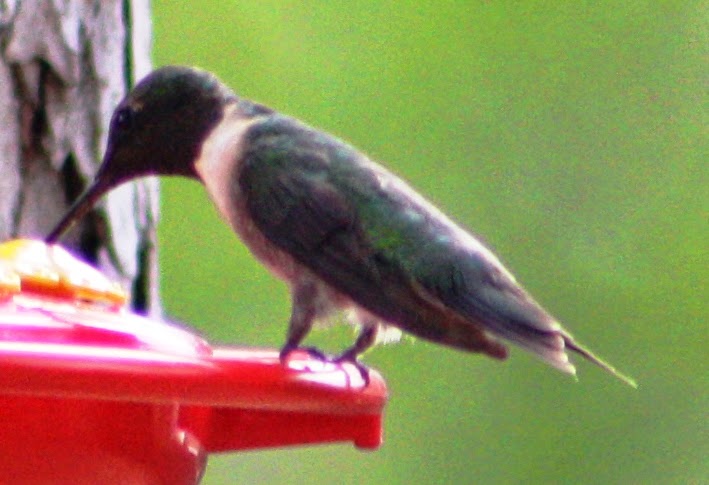
Hummingbird at feeder in Marble Falls, Texas. Photo by Darla Sue Dollman.

The Precision Balancing Act of Feeding

Hummingbirds are blessed to have plants built especially for them, plants that grow with their flowers long and thin and hanging from the end of branches to protect them from insects. These flowers are perfect for the hummingbird with its precision flying capabilities, hovering in place like a helicopter while they extract the nectar.

Red Yucca flowers are perfect for hummingbirds, providing a perch for their tiny feet. 
Photo by Darla Sue Dollman.

The nectar is pure sugar, high energy food, but it takes a tremendous amount of energy and wing movement for the bird to hover in one place while it finishes its meal! They have to eat every 15 minutes or they will literally starve to death because of the energy required to pump their hearts. In order to survive the night their body temperature drops by half and their heart rate reduces from 600 beats per minute to 36.

 Hummingbird in Rio Rancho, New Mexico. Photo by Darla Sue Dollman.

As explained in Nat Geo Wild, the birds is forced into a careful balancing act. No other bird is capable of performing this precision balance act in order to obtain its meal.

Hummingbird photo by Darla Sue Dollman.

Sometimes, all the precision balance in the world will not keep the flower in place, though. We had beautiful, tall, purple flowers growing in the shade behind our house in Texas and just as soon as a flower would bloom on a stalk, a hummingbird would stop by for a drink and knock the flower from the branch. No worries there! The next morning, a new flower would take its place! Like everything else in nature, there is a symbiotic relationship between hummingbirds and many flowering plants.

Flight of the Hummingbird

The most remarkable aspect of hummingbirds is the way they fly. All birds lift on the downstroke, then fold their wings on the upstroke, except for Swifts, who are relatives of the hummingbirds. Their wings beat from 80 to 200 times per second!

Hummingbird eating. Photo by Darla Sue Dollman.

They move like a helicopter in all directions, including straight up and down and can even hover in place. I often see them hovering in front of me, waiting for me to hang the feeder in the backyard!

Hummingbird at rest, singing. Photo by Darla Sue Dollman.

The bird must get oxygen to its muscles and its heart beats 400 times per minute when perched, 1200 beats per minute in flight. The blood circulates throughout the body in less than one second. They are truly extreme athletes. They spend 80% of their day perched to rest and groom.


Hummingbirds keep their wings stiff and do not fold them. They rotate their wings at the shoulder, which is what gives them power and advantage, the most accomplished flyers that have ever taken to the air, according to Nat Geo. They can remain in the air for hours. They can fly upside down and rotate on the spot to obtain nectar from hard-to-reach flowers. Watching hummingbirds in flight is an amazing experience.

Hummingbird in flight. Photo by Darla Sue Dollman.

Migration

Most hummingbirds in the US and Canada migrate south in the fall and spend their winters in Mexico or Central America, but some stick around. I've seen hummingbirds overwinter in the Hill Country of Texas. Ruby-throated hummingbirds, which I've seen in Texas and New Mexico, migrate from Ontario to Texas, the Gulf of Mexico or Central America. 
Hummingbird in my backyard in Rio Rancho, New Mexico. Photo by Darla Sue Dollman. 

Baby Birds!

Male hummingbirds do not help with the nesting, so the female is left with a lot of work as their nests are built in a cup shape and often formed with a combination of spider silk and mud. It can be as small as a walnut shell. One of my neighbors pointed a nest out to me once and I was shocked to learn that the bird I thought was simply sitting in a nearby tree was protecting a nest where a branch connected to the trunk. There are usually two eggs and incubation lasts 14 to 23 days. Momma feeds the babies by regurgitating nectar into their tiny mouths.

Baby hummingbird in our backyard, Rio Rancho, New Mexico. Photo by Darla Sue Dollman.

Sources: