Wednesday, April 9, 2014

Hummingbirds: God's Little Miracles in the Skies

 
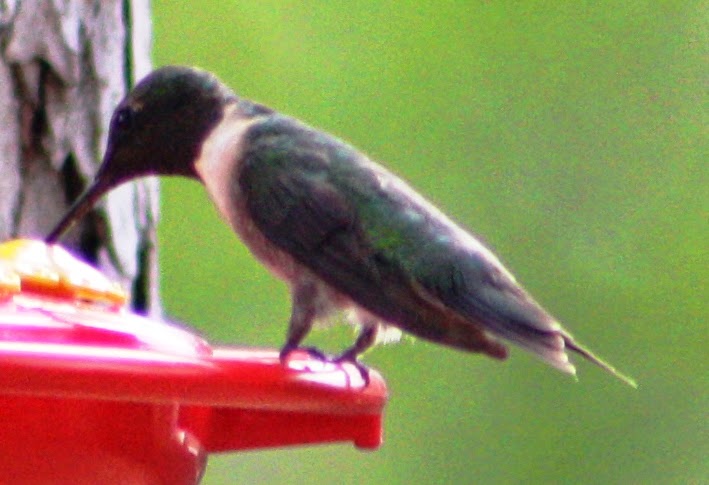
Lovely little hummingbird in my backyard in Rio Rancho, New Mexico. 
Photo by Darla Sue Dollman.

 Close your eyes and imagine. Picture tiny birds the size of your pinky hovering in front of your face, frustrated, impatient, waiting for you to hang his feeder so he can drink his fill of sugar water.

Hummingbird photo by Darla Sue Dollman.

You hang the feeder and within seconds a dozen birds are drinking, flitting back and forth, flying around your head, flying around each other as if they are sparring, which is a fairly accurate way to describe their aggressive behavior. These funny, charming, lovely, and yes, aggressive little birds are hummingbirds, and watching them is pure delight.
   
Hummingbird in the Texas Hill Country singing in the early morning hours. 
Photo by Darla Sue Dollman.

Hummingbirds are the smallest warm-blooded creatures on earth. In fact, the Bee Hummingbird is the smallest at 5 cm. They are tiny and bold and appear to be playful, but the "chase" around the feeder is remarkably aggressive, territorial behavior. There is a company in California that makes a robotic hummingbird, and real hummingbirds will even dive-bomb at the robot to defend their territory!

Hummingbird at feeder in Marble Falls, Texas. Photo by Darla Sue Dollman.

The Precision Balancing Act of Feeding

Hummingbirds are blessed to have plants built especially for them, plants that grow with their flowers long and thin and hanging from the end of branches to protect them from insects. These flowers are perfect for the hummingbird with its precision flying capabilities, hovering in place like a helicopter while they extract the nectar.

Red Yucca flowers are perfect for hummingbirds, providing a perch for their tiny feet. 
Photo by Darla Sue Dollman.

The nectar is pure sugar, high energy food, but it takes a tremendous amount of energy and wing movement for the bird to hover in one place while it finishes its meal! They have to eat every 15 minutes or they will literally starve to death because of the energy required to pump their hearts. In order to survive the night their body temperature drops by half and their heart rate reduces from 600 beats per minute to 36.

 Hummingbird in Rio Rancho, New Mexico. Photo by Darla Sue Dollman.

As explained in Nat Geo Wild, the birds is forced into a careful balancing act. No other bird is capable of performing this precision balance act in order to obtain its meal.

Hummingbird photo by Darla Sue Dollman.

Sometimes, all the precision balance in the world will not keep the flower in place, though. We had beautiful, tall, purple flowers growing in the shade behind our house in Texas and just as soon as a flower would bloom on a stalk, a hummingbird would stop by for a drink and knock the flower from the branch. No worries there! The next morning, a new flower would take its place! Like everything else in nature, there is a symbiotic relationship between hummingbirds and many flowering plants.

Flight of the Hummingbird

The most remarkable aspect of hummingbirds is the way they fly. All birds lift on the downstroke, then fold their wings on the upstroke, except for Swifts, who are relatives of the hummingbirds. Their wings beat from 80 to 200 times per second!

Hummingbird eating. Photo by Darla Sue Dollman.

They move like a helicopter in all directions, including straight up and down and can even hover in place. I often see them hovering in front of me, waiting for me to hang the feeder in the backyard!

Hummingbird at rest, singing. Photo by Darla Sue Dollman.

The bird must get oxygen to its muscles and its heart beats 400 times per minute when perched, 1200 beats per minute in flight. The blood circulates throughout the body in less than one second. They are truly extreme athletes. They spend 80% of their day perched to rest and groom.


Hummingbirds keep their wings stiff and do not fold them. They rotate their wings at the shoulder, which is what gives them power and advantage, the most accomplished flyers that have ever taken to the air, according to Nat Geo. They can remain in the air for hours. They can fly upside down and rotate on the spot to obtain nectar from hard-to-reach flowers. Watching hummingbirds in flight is an amazing experience.

Hummingbird in flight. Photo by Darla Sue Dollman.

Migration

Most hummingbirds in the US and Canada migrate south in the fall and spend their winters in Mexico or Central America, but some stick around. I've seen hummingbirds overwinter in the Hill Country of Texas. Ruby-throated hummingbirds, which I've seen in Texas and New Mexico, migrate from Ontario to Texas, the Gulf of Mexico or Central America. 
Hummingbird in my backyard in Rio Rancho, New Mexico. Photo by Darla Sue Dollman. 

Baby Birds!

Male hummingbirds do not help with the nesting, so the female is left with a lot of work as their nests are built in a cup shape and often formed with a combination of spider silk and mud. It can be as small as a walnut shell. One of my neighbors pointed a nest out to me once and I was shocked to learn that the bird I thought was simply sitting in a nearby tree was protecting a nest where a branch connected to the trunk. There are usually two eggs and incubation lasts 14 to 23 days. Momma feeds the babies by regurgitating nectar into their tiny mouths.

Baby hummingbird in our backyard, Rio Rancho, New Mexico. Photo by Darla Sue Dollman.

Sources:


Tuesday, April 8, 2014

The Gyrfalcon: The Bird of Royalty

This photograph of a Gyrfalcon, taken in Iceland by Ómar Runólfsson, is by far the most beautiful I have ever seen. The photo was taken on October 9, 2011.

The Gyrfalcon (Falco rusticolus) is the royalty of raptors. It lives and hunts in the northern realms of our world on Arctic coasts and the islands of Europe, Asia, and North America. It is a remarkably beautiful and equally intimidating bird that is often used in the sport of falconry.

The Origin of the Gyrfalcon's Name

The first part of this raptor's name may come from the German word geier, or vulture, which would accurately describe both its intimidating size and its habit of circling its prey, though it is also believed to come from the Latin gyrus, for curved path. Its Latin scientific name is a combination of the word falco, for falcon, and rusticolus, meaning someone who lives in the country.

The Intimidating Size of the Gyrfalcon

Male Gyrfalcons, referred to as Gyrkins, average 24 inches long, weigh as much as 3 pounds, and have wingspans of 51 inches. Females are generally larger than the males, averaging 26 inches long, 4.6 pounds, and with a wingspan of 64 inches. Gyrfalcons have pointed, broad wings and longer tails than Peregrine Falcons. Plumage varies from white and silver to brown and black. White Gyrfalcons are the only predominantly white falcons. Juvenile Gyrfalcons are often darker than the adults, but the coloration of males and females does not differ according to gender. Gyrfalcons generally live to be 20 years old.

Breeding and Brooding

Gyrfalcons reach sexual maturity at three years old and mate for life. Gyrfalcons rarely build their own nests. Instead, they use a bare cliff edge, or cliff nests previously abandoned by their enemies--golden eagles and ravens. Gyrfalcons lay between one and five buff-colored eggs with brown markings. They incubate the eggs for up to 35 days. According to the Cornell Lab of Ornithology, female Gyrfalcons have been known to catch more food than they need at the moment and will sometimes store their cache within 100 feet of their nests during breeding season. Gyrfalcon chicks leave the nest at 7 to 8 weeks and are independent of their parents within 3 to 4 months. Like many other birds, they often stay with their siblings their first winter or until they completely adjust to life on their own.

The Skillful Hunter

Gyrfalcons are large, regal birds and skillful hunters. They have a long history in their relationship with humans through the sport of falconry and their ownership was once reserved for kings. They are also expensive birds and carefully protected by their owners and breeders. According to Peregrine Fund.org, the primary diet of Gyrfalcons consists of ptarmigan and grouse, but they also eat a variety of sea and water birds, squirrels, and lemmings. They have very keen eyesight, which is helpful when hunting in arctic climes where the coloring of the wildlife often matches the surroundings. Gyrfalcons catch their prey both in the air and on the ground using a super-fast, low-flight chase. Just before the catch, they fly straight up then dive down upon their prey at extremely high speeds. The Gyrfalcon also has great stamina and will often exhaust its prey then pounce on it with tremendous power on impact, knocking its prey to the ground.

Threats to Survival

The Gyrfalcon's natural predator is the Golden Eagle, though the two rarely engage, they are simply well-matched in strength and skill. Ravens are threats to Gyrfalcons only because they like to eat Gyrfalcon eggs and hatchlings. As with most wildlife, the greatest threat to Gyrfalcons is humans through poisoning, accidents with automobiles and other machinery, hunting, and pollution created by pesticide use. Like many other large, wild birds, the Gyrfalcon was listed as "near threatened" by the IUCN until 1994 due to deaths caused by pesticides. Since that time, they have made a remarkable recovery in numbers, are no longer considered at risk, and once again roam comfortably as the kings of the sky.

Sources:

  • “Gyrfalcon.” Natural History Notebooks. Canadian Museum of Nature. Retrieved July 31, 2010.
  • "Gyrfalcons." Peregrine Fund.org. Retrieved July 23, 2010.
  • "Gyrfalcons.com." FalconsCanada.com. Retrieved July 23, 2010.
  • "Gyrfalcon: Life History." All About Birds. Cornell Lab of Ornithology. Retrieved July 23, 2010.

Monday, April 7, 2014

Flowers and Bees: A Swarm to Remember

My favorite New Mexico wildflower. My husband keeps trying to convince me they are weeds, but I don't see how anything so beautiful could be called a weed. The purple flowers open one at a time, moving down the stem, curling like a caterpillar. Photo by Darla Sue Dollman 

These flowers grow anywhere from six inches tall to ten feet tall. They grow on stalks in groups of two or three or a dozen. I see them in the desert and the city. Photo by Darla Sue Dollman.

We didn't have any wildflowers in the desert last year. We didn't have any rain in the spring! We had one sprinkling of snow and just enough rain one winter night to damage our roof when the wind ripped off the tiles and sent them flying into the arroyo. 

Bee on sunflower in Rio Rancho, New Mexico. Photo by Darla Sue Dollman. This is my favorite bee photo. It seems to be overwhelmed by its pillow of pollen in the center of a large sunflower. 

I had a strange incident with bees last year, almost one year ago, in fact. I was walking my chocolate lab, Holly, and carrying my chihuahua, Chewy, in my arms. I had just checked the mail and turned around when suddenly, I heard the strangest sound, like a dozen chain saws revving up at once.

Bee on Russian Sage. Photo by Darla Sue Dollman.

When we started the walk, as we rounded the first corner, I noticed one of our neighbors working with a saw in his garage. At first, when I heard the buzzing sound I assumed he had changed tools to something larger and returned my attention to the mail in my hand. 

Wildflowers at the Arizona/New Mexico border. Photo by Darla Sue Dollman.

Then, out of the corner of my eye I saw a black cloud moving over the house across the street. It was one of those odd moments where something is so completely out of place that you actually have to stop and think for a few seconds about what it could possibly be, even though you know what is coming toward you...and within seconds we were engulfed in a thick cloud of bees swirling around my face, head and body. 

Bee on sunflower in Rio Rancho, New Mexico. Photo by Darla Sue Dollman. 

I could barely see Chewy in my arms and could no longer see Holly at all, though she was still sitting very quietly near my feet. I don't know what was stranger, the fact that the bees we were surrounded by the largest swarm of bees I'd ever seen or heard of, or the fact that none of us felt the least bit compelled to move, and the bees were not stinging. They would come close and look at my face, then buzz off. I couldn't see the dogs, but I could feel that they were holding perfectly still. I don't know how long it lasted, but it seemed a very long time, or as if time had stopped. 

Bee on flowers in Loveland, Colorado. Photo by Darla Sue Dollman. 

It was dark and loud and the movement of the bees felt like a slight breeze against my skin. To be honest, I lost all concept of time. I have no idea how long we stood in the middle of the street (there are no sidewalks in my neighborhood so we always walk in the street).

Pollen-happy bee in Rio Rancho, New Mexico. Photo by Darla Sue Dollman.

As suddenly as they had swarmed around us, swirling past our faces, between our bodies, never landing, they just as suddenly started moving upward, forming what appeared to be a black tornado rising above our heads. We continued to stand in place, but I did look upward and that is precisely how they appeared, like a tornado. They moved sideways like a cloud, then to the side again forming a second cloud. 

Bee in Loveland, Colorado. Photo by Darla Sue Dollman.

They appeared to be following a leader, their movements synchronized, like a dance, and I began to feel as if I was experiencing something magical. Then the cloud of bees moved to the front of my neighbor's house, hovered near his door, rose up the front of the house, over the roof and back down the other side, and the majority of the bees disappeared.

Bee on Russian Sage in Rio Rancho, New Mexico. Photo by Darla Sue Dollman.

It was such a strange sensation. I wasn't the least bit afraid--perhaps because not one even attempted to land on me--but I was curious. I'd never seen or heard of anything like this, particularly in New Mexico. Last year, however, I did have a few friends post explanations for what they thought happened, including the possibility that the swarm lost their queen. If you have any suggestions feel free to leave a comment.

In the A to Z Challenge, F is for Flowers! Happy spring everyone! 


Saturday, April 5, 2014

Eurasian Lynx: National Symbol of Macedonia

This photo of a Eurasian Lynx was taken by David Castor. I chose this photo because it shows the great beauty of this magnificent creature, this gift to us from God, and I appreciate Mr. Castor's permission to use the photo on my blog. According to the information listed on the photo, it was taken at Skåne Zoo (Swedish: Skånes djurpark), near Höör, Scania, southern Sweden in 2009.


Today's blessed little creature featured in the A to Z Challenge is the Eurasian Lynx, a lovely animal related to the American Bobcat. I have lived in Bobcat territory my entire life and have never seen one because they are private, secretive, and silent hunters. Like its American cousin, the Bobcat, the Eurasian Lynx is a fierce ambush predator, using the cover of the forest to stalk its prey. They belong to the mountains where they live, and the mountains belong to them. We are just visitors and should respect their privacy. 

With that said, I do agree with having animals in zoos. There are too many people who do not respect or appreciate that animals are gifts from God and zoos are the only way we have to protect these animals. 

Aww! Now who could resist a photo of a sunbathing, sleeping Lynx? In stark contrast to its predatory nature, the Eurasian Lynx communicates by mewing, purring, and using other sounds resembling the common house cat. This lovely photo was taken by Ralph Schmode and we appreciate the fact that it is in the public domain so we can all admire the beauty of this animal. 

The Eurasian Lynx

The Eurasian Lynx (Lynx lynx), has a body that has adapted to its mountain forest habitat with strong legs and webbed, furry paws that provide speed, stability, and silence when moving on snow. In fact, it can live in its territories for years before it is finally spotted. Once it spots its prey, the Eurasian Lynx remarkably begins to behave like my own cat, Niblet. Niblet is a domesticated cat and never leaves the house, spending far too much time playing games on the computer, but when he spies a bird outside my bedroom window he makes a chattering sound--not very sneaky!

Niblet playing games on the computer. Niblet is a Maine Coon, which is also an exceptionally large cat, but he is what is known as a domesticated cat. He thinks he's a wildcat, but he's only wild at night when he runs through the house while I'm trying to sleep.

Like a house cat staring out the window at a bird, the Eurasian Linx will also chatter when it sees unreachable prey, which may explain why Niblet chatters--he knows he cannot reach the bird. If a Eurasian Lynx is on one side of a mountain and sees a rabbit hopping through the snow on the opposite mountain it will instinctively begin to chatter. Perhaps this is his way of saying, "I'll get you next time!"

A Large Lynx, but Small Big Cat

The Eurasian Lynx is also the largest animal in the Lynx family standing 28 inches to the shoulder. The Eurasian Lynx is generally 51 inches long. Males weigh 40 to 60 pounds while females average 40 pounds, so there is not that much difference in size between males and females. They are considered a medium-sized wild cat.

Although there is snow on the ground, this Eurasian Lynx is showing off its reddish-brown summer coat. Perhaps it is hoping for an early spring! This lovely photo is used courtesy of photographer Böhringer Friedrich. The photo was taken in 2011.

Another interesting fact about the Eurasian Lynx is how its coat changes color. It is either red or brown in summer, then thickens with a silvery gray shade in winter, but its belly remains white year-round. Its outer fur is marked with a variety of black spots and sometimes stripes.

Lifestyles of the Mountain Big Cats

European Lynx generally live to be 17 years or older, which is pretty old when you think about it, and probably due to the fact that they stay hidden.

They prefer to make their homes in mountain and woodland areas with rocky outcroppings where they can watch for their favorite prey, deer. They also eat rabbits, rodents, wild boar and reindeer and can kill animals four times their own size. They are stalkers, attacking with a quick burst of speed and killing with a swift, sharp bite to the neck.

They are great tree climbers, which adds a tremendous boost to their stalking ability. Like many animals, such as rattlesnakes, mountain lions, and coyotes, they prefer to hunt in the early morning and at dusk, then sleep during the day.

Creating a Family

The female Eurasian Lynx is able to have babies at 2 years old, though males mature a year later. Eurasian Lynx start thinking about having children sometime between January and March and once the female is pregnant it takes 68 days, or a little over two months before she gives birth to two or three kittens.

Pregnant females build their home, or den, using tree branches and roots for cover. Kittens are born blind, helpless, and with brown fur, gradually acquiring their adult colors with age. They begin to eat solid food at about six weeks old. They remain with their mothers ten months. Eurasian Lynx have kittens only once a year. Females stop having kittens at the age of 14.

Threats to Survival

The Eurasian Lynx once ranged the European forests, but their populations gradually declined. In spite of this fact, they are listed as animals of Least Concern with the IUCN, most likely because of their large numbers in Russia. The largest population of Eurasian Lynx--more than 90%--can be found in the Siberian forests, and I've noticed that many of the Eurasian Lynx in zoos come from this area. Another large population of Eurasian Lynx lives in the Carpathian Mountains.

This is a magnificent photograph by Michael Gabler. Notice the tufts of fur sticking up from the ears, the reddish-brown summer coat, those lovely eyes, and "Grandma, what big teeth you have!" Do not be fooled by the size of this cat, it is a fierce hunter! 

The Balkan Lynx in Macedonia, Slovenia, and Albania is nearly extinct, but it remains the National Symbol of Macedonia. Their numbers were reduced drastically in these areas, and other European countries, due to poaching. In Switzerland, the Eurasian Lynx was extinct in 1917 and reintroduced in 1978, but numbers are once again declining due to poaching. Poaching remains the greatest threat to the Eurasian Lynx.

Sources:


Friday, April 4, 2014

Leafy Sea Dragon: Dragons of the Sea

The Leafy Sea Dragon, (Phycodurus eques), is a marine fish in the family Syngnathidae. Photo by "©Ta-graphy"

The Leafy Sea Dragon, a sea horse with the appearance of floating algae, is a graceful, colorful, master of disguise, resembling its the environment around it, moving slowly and smoothly with the movement of the ocean, it appears to be a plant. Looking close, it appears to be a magical ocean dragon. Perhaps this is why it has always been a favorite of my grandchildren and I. We love to watch videos of this magnificent creature as it drifts, floats, and gives birth. 

D stands for Dragon, the Leafy Sea Dragon, Dragon of the Sea

The Leafy Sea Dragon (Phycodurus eques) is found in the sandy, coastal water from Kangaroo Island to Jurien Bay in Australia. It is a member of the sea horse family and bears an uncanny resemblance to the mythical creature it was named for, but its behavior more closely resembles the gently floating algae that shares its ocean home.

Leafy Sea Dragon Anatomy

The Leafy Sea Dragon, a relative of the Weedy Sea Dragon and the Sea Horse, belongs to the Syngnathidae family, which also includes Pipe Fish. The Leafy Sea Dragon generally grows to be slightly larger than a Sea Horse, or 8 to 10 inches. It has yellow eyes that move independently of each other and an elongated snout like the Sea Horse, which it uses to eat its favorite crustaceans and plankton, but it has no teeth. It has a slender, bony trunk.

Leafy Sea Dragon (Phycodurus eques): Dragons of the Sea. Photo by Wendy Rathey, taken in 2006. 

Although it has no pelvic fins, it does have fins on the sides of its neck for turning, steering, and hovering in place, which helps give it the appearance of a floating piece of seaweed. Hovering in place, sometimes for days at a time, enables the Leafy Sea Dragon to camouflage itself from predators as well as to catch food. The Leafy Sea Dragon differs from its Sea Horse and Weedy Sea Dragon relatives because it is covered in leaf-like appendages that are not used for movement, but to help it blend with its environment. The Leafy Sea Dragon is also able to change its color to blend with its environment.

The Mating Dance

Leafy Sea Dragons perform a graceful mating dance, and when it is time, the female deposits 100 to 250 bright pink eggs in oxygenated, spongy, cup-like devices on the "brood patch" on the male Leafy Sea Dragon's tail. The eggs are fertilized as they are deposited onto the tail.

Leafy Sea Dragon Video on You Tube.

According to National Geographic Online, the eggs remain on their father's tail for four to six weeks, gradually turning purple or orange, then the father begins a two day process of pumping his tail or brushing it against nearby seaweed to let the babies know it is time for them to leave their eggs. The infant Leafy Sea Dragons leave their eggs and immediately begin searching for food on their own. According to the Unique Australian Animals Website, infant Leafy Sea Dragons being eating zooplankton and gradually begin to eat sea lice over their first few days of life. In spite of the large numbers of eggs, only 5% of Leafy Sea Dragons survive their first year.

Threats to Survival

The Leafy Sea Dragon is classified by the International Union for the Conservation of Nature and Natural Resources as being Near Threatened. Because they are slow swimmers, they are easily caught--and highly prized--by collectors, in spite of the fact that they are rather fragile and rarely survive outside their natural environment.

Leafy Sea Dragon (Phycodurus eques)  at Rapid Bay Jetty, Gulf St Vincent, South Australia. Photographed by Peter Southwood on February 2, 2014.

They are also killed for use in alternative medicines. As they spend most of their time near the coast, they are vulnerable to pollutants and sometimes wash up on shore during storms.

Celebrating and Protecting the Leafy Sea Dragon

The Leafy Sea Dragon was adopted by the Australian Government as the Official Marine Emblem of South Australia in 2001. It is protected by the Australian Government and permits are required to possess any Leafy Sea Dragon, dead or alive. The Leafy Sea Dragon is a very fragile creature and there are hefty fines for capturing the Leafy Sea Dragon and removing it from its natural habitat.

Sources:

  • "Leafy Seadragon." Government of South Australia. Retrieved March 4, 2010.
  • "Leafy and Weedy Sea Dragon." National Geographic Online. Retrieved March 4, 2010.

Thursday, April 3, 2014

Coyotes: Tricksters of the Desert

I watched this coyote leaping about in an arroyo near Bernalillo, New Mexico, trying to reach a parliament of burrowing owls congregating at the top of the arroyo's steep walls. She finally gave up. In this case the trick was on her, poor thing. She looked hungry! Photo by Darla Sue Dollman.

One of the many reasons I like this blog is because I can be so flexible. Sometimes I discuss an animal I've never seen before, but want to some day, like the Leafy Sea Dragon. Sometimes I discuss important animal issues, like slaughterhouses and wild horse roundups. And sometimes, I just tell stories. Today is a story day. Today I will tell coyote stories: C is for Coyote!   


I once had a dream about an old woman who was wearing many skirts and a white blouse with a woven belt tied about her waist. She seemed to be from a time long ago. She had two coyote pelts tied to her belt. She beckoned to me and I followed her into the forest behind our house in Texas. She built a fire and I sat beside her and she gave me some tea. She patted the coyote pelts and smiled at me as if she was trying to tell me something. When I woke up I immediately search on the internet to try to find meaning in the dream. The coyote animal totem represents many things. It is a teacher of wisdom and humor, but it is also a warning not to take things seriously, to find balance between wisdom and pleasure. Most importantly, the coyote is a trickster. It reminds us that we can be easily fooled. At that time in my life I was trying to heal the pain from two broken relationships, people who had tricked me unmercifully and made me look and feel foolish. Perhaps the old woman was trying to tell me the tricksters were dead, that it was time to move on with my life. Or perhaps it was just a dream. Not everything that happens in life has a hidden meaning, but I like to keep my mind open, and when I thought back on my experience with coyotes I realized the definition fit.  

Buddy and Holly at dusk in Rio Rancho, New Mexico. Photo by Darla Sue Dollman.

Coyotes can be found from Central America, through Mexico, the United States and into Canada, and they move further north every year as they adjust. They like to roam in packs at night and you can hear them howling for their family members Dawn and dusk are dangerous times in coyote country, and spring to summer are dangerous seasons. The coyotes hunt at dawn and dusk, and in springtime they have their babies and are very protective.

People in rural areas talk about "tricks" the coyotes play on house pets. They will actually play with domestic dogs, and some people say they will bread with domestic dogs, creating offspring called coydogs. We have a friend who was told he has a coydog, and I suspect this is true. The problems with dogs and coyotes are simple and logical--coyotes are wild, so they need to produce offspring; they need to eat; they like to play; and they are territorial.
Lucy, my friend's "Coydog," is one of the sweetest, gentlest dogs I know.

I have been told that coyotes will send a female close to the home to attract domestic dogs. Then they lure the dogs close to their territory and the pack attacks and eats the dog--one of many reasons why I do not allow my animals out at night alone. But, accidents happen. One day I came out the front door and saw two coyotes playing with a black dog on the side of my house. When they ran off I realized the black dog's tail was down--it was a black coyote. 

Yes, these also exist and photos of them can be found all over the internet. On that particular day, though, I was wary of letting the dogs out. Our two chocolate labs were still young and easily lured away from home. As I prepared for bed I could hear the coyotes howling nearby. The dogs whined to go outside, but I wouldn't let them. I had taken them for a walk an hour earlier and knew they wanted to chase the coyotes, so I went to bed.

Around midnight, my husband woke me up. He came home from work at 11 and saw the dogs whining at the door, so he let them out. He didn't hear the coyotes, but he knew immediately that something was wrong when the dogs ran through the apple orchard and out into the neighbor's field. 

In the Southwest, most fields are filled with sagebrush and it's nearly impossible to see coyotes because they blend with the tan color of sage stems and trunks and the sand and soil. They also seem to almost creep so you can only see the tops of their heads.

Do you see the coyote? It's there! They blend so well it's nearly impossible to see them! Photo taken in Rio Rancho, New Mexico by Darla Sue Dollman.

Steve was in a panic. He'd been searching for the dogs for an hour and there was no sign of them, but the next day was Saturday and he had to get up in six hours to go to work. So, I got out of bed, climbed into my truck and drove through our neighborhood calling for the dogs. I took a huge flashlight and walking stick and walked around our property. I didn't even hear the coyotes anymore, which made me feel kinda sick inside. I knew something was terribly wrong. 

I drove up and down the highway miles away in case they were led far from home and were lost, then I returned home around four in the morning. I parked in front of our house and left the truck lights on shining over our hills with the radio on hoping that if they were lost they would see and hear me in the dark, then I waited.

I didn't have to wait long. I fell asleep for about ten minutes, then I heard a whining sound and looked out the open truck window to see Holly beside me. I turned off the truck and jumped out, grabbing her in my arms. I called out for Buddy, but didn't hear or see him. I reached for the flashlight and saw him moving slowly down the road. I felt them all over and they felt fine, so I brought them inside and they collapsed on the living room rug. I lay down between them, relieved to have them home.

Buddy is a desert rat. He loves to explore the desert! He is also fearless, which can be a problem. Photo taken in Rio Rancho, New Mexico by Darla Sue Dollman.

About an hour later I woke up feeling strange. I realized my arm was damp. It was blood. I rolled Holly over and found bites on her stomach and legs. My husband was leaving for work, so he helped me carry the dogs to the truck. I called the vet and she met me in town (thank you God for small town vets) and opened her shop. Buddy still seemed fine, so I left him in the truck. 

Buddy and Holly on my bed. (Don't tell Dad! I put a sheet down to catch the dog hair!) Photo taken in Marble Falls, Texas by Darla Sue Dollman.

The vet checked Holly over and told me she was covered in coyote bites and lucky to be alive. Then she said, "Where's her brother? They never go anywhere alone!" I told her he looked okay to me, and she said, "No, they would have gone for him first as he was the greater threat. He will have bites on his back and legs where they tried to take him down." Sure enough, when we brought Buddy inside she found bites on his back and legs, too, but they weren't bleeding and they were covered with fur, so I could barely see them. She told me they were lucky to be alive. 

Buddy and Chewy the Chewchewcabra in Rio Rancho, New Mexico. Photo by Darla Sue Dollman.

So, we moved to Texas for four years, lived on five acres of forest surrounded by forest, saw snakes every day, vultures, ringtail cats, heard mountain cats, saw every animal you can imagine and heard coyotes every single night, but never saw a single one. 

Two years ago we moved to New Mexico, to a county that has an ordinance against lawns due to drought. The dogs need to run so for a year I took them up to the mesa every day for a run. Then one spring evening I came home late and we arrived at the mesa at dusk. I should have known better. We saw coyotes in the road as we headed for the mesa. 

Coyote walking through the mesa at dusk. Photo by Darla Sue Dollman.

I drove the dogs around for awhile, then came back in toward the houses at the edge of the desert and decided to walk them on the leash. Buddy loves to roll in the dirt, but I didn't want to take any chances. 

Buddy love to roll around in the warm sand. Photo by Darla Sue Dollman.

I opened the door and Holly jumped out. She reached the end of the truck and was immediately surrounded by coyotes. They appeared out of nowhere, like ghosts in the desert. Buddy and Chewy jumped back into the truck and I took my walking stick and ran toward them, but they acted as if I wasn't even there. They were pushing her toward a dirt bike track, and moving fast. I jumped into my truck and raced after them, driving right between them. They turned and came after me! I started swinging my stick and Holly ran behind me and jumped into the truck. I climbed in and shut the door, but I was stuck with the center of my truck on top of a dirt mound and the coyotes surrounded us. They stood their ground, refusing to leave. 

Coyote refusing to leave when I was stranded in the desert. Photo by Darla Sue Dollman.

I called my husband and asked him what to do. We debated calling the police because I couldn't get out of the truck, and couldn't get it to move by rocking it back and forth. Suddenly, the wheels caught, the truck started to move, and the coyotes started to leave.

Coyotes leaving. Photo by Darla Sue Dollman.

We made it out safely, but I decided to avoid the mesa, even though people often take their dogs there for walks. It was too frightening and I did not want to go through that again. We decided to take the dogs for a walk by the road where we saw more people. We stopped the truck and when I opened the door my chihuahua jumped out. He started to run then froze. A white truck was coming down the road and I thought he was looking at the truck. Then I noticed the man was waving frantically. Chewy was only about 20 feet away, but I started to run for him and he started hopping backwards, then turned and ran toward me just as they coyote popped its head up from the brush. It lunged out of the sagebrush at Chewy at the same moment he leapt over the ditch and into my arms. The coyote turned and ran back into the sagebrush. I put Chewy in the truck and as we drove away I could barely see the coyote's head poking out above the sage. 

Do you see the coyote? Look closely. This is how close they come to the houses in New Mexico--right up to your door. Photo by Darla Sue Dollman. 

I still needed to exercise the dogs. We were going to give it one more try--the hills next to the high school. We drove up there the next day. The hills were filled with joggers and high school students and people walking their dogs, so we assumed we were safe. We had a great time, then I started loading the dogs into the truck. I turned around for Holly and she was gone. I called for her frantically, then took out my camera to use it like binoculars. I spotted her at the base of the hill, and just on the other side of a huge tree where she couldn't see it was a coyote with its teeth bared. 

By this time my dogs had learned the word "coyote!" I screamed as loud as I could and started running as fast as I could. I reached Holly with the coyote less than six feet away. It growled at us then slowly turned around and walked away. I ran Holly back up the hill then chased down a group of student joggers to warn them about the coyote as she was on the same trail they were running on--they had just passed us.

Using my camera like binoculars, I spotted this coyote on the opposite side of a tree. Oddly, it didn't seem to see my dog. It seemed to be growling at me! Photo by Darla Sue Dollman.

No more desert, I told my husband, and I started walking the dogs on leashes in the neighborhood, but one of my neighbors mentioned it would be safe if I went up in the mid-day. So, around lunchtime I decided to take the dogs up one more time. It was a Saturday and surprisingly crowded on the mesa with dirt bike riders and three-wheelers and four-wheel drivers jumping the mounds, but as soon as I reached the mesa the strangest thing happened--I saw the word "dog" in my mind. 

Now, I do not claim to be psychic, and it was nothing like that, I just saw "dog," just like that, in my mind. I found an open spot that we had visited before--plenty of room with no trees or high sagebrush to hide coyotes, but I felt as if we were being watched. We were there a few weeks before with my husband and I had the same feeling--someone was watching me. I saw the word DOG in my mind again. I just couldn't do it. I knew it had to be a warning. I apologized to the dogs and started to back up. I said, "coyote" and they all started looking around, and relaxed--they were not going to leave that truck. 

The DOG in the sagebrush. Photo by Darla Sue Dollman.

Suddenly, I saw the sagebrush moving. A dark brown animal was crawling out. It was a brindle dog, short, skinny, it's ribs showing. It crawled out in front of my truck, rolled onto its back and lay there with its four paws in the air, then turned and stared at me. 

I climbed out of the truck with the water dish and water and gave him water slowly, then put down some kibbles I had in a baggie in the truck. I waited a few minutes. He seemed unsure of me, but he wasn't about to let me leave, either. I gave him some more. Another truck pulled up and asked if the dog was mine. He said he was watching us from a few roads down and wanted to know if I needed help. It was after dark before we convinced the dog to climb into the truck, but I took him home. 

Baby in the desert. Photo by Darla Sue Dollman.

I spent a month looking for his owners and finally adopted him. We named him Baby because that's what I kept saying to him to draw him closer to me. "Come here, Baby!" And that's how we came to have a pack of four dogs, with the help of the local pack of coyotes, which we still hear every night as they roam through our neighborhood. 


Wednesday, April 2, 2014

Burrowing Owls: Clowns of the Desert


"Well, hello there!" Burrowing Owl in Bernalillo, New Mexico. Photo by Darla Sue Dollman.

The first time I saw a Burrowing Owl, also known as a Prairie Owl, was in Wellington, Colorado. We once owned 35 acres of rolling hills and prairie land and we didn't have prairie dogs, but our neighbors across the road had plenty. I love prairie dogs and used to stop and watch them on my way home from yoga classes that I took with my granddaughter. She also loves prairie dogs so I would watch them at night and share my stories with her the next day. 

One night, as I stared off into the field, I noticed two heads sticking out of a hole that did not look like prairie dogs. They were clearly watching me, even though I wasn't close. They resembled prairie dogs from the top, but they seemed much more shy. Well, they are shy, but they also share burrows with prairie dogs. Yes, I was looking at a Burrowing Owl! They are wonderful to watch as they perch on one leg, cock their heads to one side, or turn their heads around backwards. They are the clowns of the desert! 

Burrowing Owls love the desert, which is where I've seen them the most, in the deserts of New Mexico. You may recognize them as the Mariachi Band from Rango.


Rango publicity trailer screenshot of the Mariachi Owl Band.

Meet the Owls...

Burrowing Owls are smaller than most owls, averaging 11 inches tall, though females are always shorter than males. They have long legs, though for some reason they prefer to use only one, tucking the other up near their fanny. They also have short tails. Perhaps they leave that second leg hanging out to make their tails look longer. I don't know. As far as raptors go, when compared to the Turkey Vulture, those poor little owls are probably a bit embarrassed about the length of their wings and tails!


Whoops! That's not an owl! Uh, yeah, those Turkey Vultures tend to enjoy showing off when it comes to their wings. This one was photographed in Llano, Texas. He claimed he was drying the food particles on his wings so they would fall off, but when interviewed by this reporter, the other raptors hanging out nearby said this fella is a bird with  Photo by Darla Sue Dollman.


Okay, much better. This IS a Burrowing Owl, photographed on the mesa outside Rio Rancho, New Mexico. He tried to strike a pose for the photograph. I think he did a good job here. You can see the spotted wings; long legs for a vulture--water or swamp birds tend to have long legs like these; the bright eyes that are so well loved on these beautiful creatures; and the short tail. Photo by Darla Sue Dollman.

The Burrowing Owl has eyes that seem to shine. They are very attractive. Their beaks are yellow or gray. They do not have protruding ears, but they do have the characteristic flat face of an owl. They have a patch of white on their chin, and they like to bob those chins up and down when they're upset. They aren't easily agitated, though, unless you threaten their young, so stay away from those babies! 


Yes, this is the coyote as she trotted out of the arroyo. I believe it is female, but I have no evidence for this except that she reminded me of a female! Photo by Darla Sue Dollman.

Ahh, babies! I was driving down I-25 once past Bernalillo, New Mexico and noticed a coyote racing back and forth in an arroyo to the east. I stopped to take his picture (of course) and noticed a Parliament of Burrowing Owls. (Yes, I do believe that is the proper term. They actually have an organized owl government.) The babies immediately scattered. They had holes in the side of the arroyo, which I believe is what was frustrating the coyote--the walls of this particular arroyo were very steep and nothing could get at those holes except the birds! Imagine how frustrating that would be to see breakfast, lunch, and dinner six feet away and not be able to reach it! Grr...


Female giving me a backward glance. Photo by Darla Sue Dollman.

The adults remained on the fence, which apparently is a favorite perch. I picked up a book at a used bookstore in Colorado once called Prairie Owl by Rob Palmer. Palmer spent three years following a family of Burrowing Owls (the terms are used interchangeably, unless of course you are a scientist) and photographing their playful antics, such as their habit of looking at humans, animals and object with their head cocked to the side when they are confused. Palmer also pointed out that Burrowing Owls seem to prefer perching on wire fences, though he did not know why. I've noticed the same habit, and I don't know, either. 


This seven foot Eastern Diamondback Rattlesnake visited our backyard in Texas early one evening while I was filling the food dishes for the squirrels. In fact, he was right beneath my foot when I sensed his presence, but not in a position to strike. He had also just finished eating, judging from the bulge in his belly, and they move a bit slower after a meal. This old fella was around for a long time judging from the length of his rattle! 

Speaking of habitat, the Burrowing Owl shares its holes with Prairie Dogs, but sometimes takes over holes left behind by large snakes, like the rattlesnake above--a seven-footer who stopped by to say "Howdy" one night when I was filling the squirrel dishes with seed at our home in Texas.

Unfortunately, rattlesnake roundups are legal, and obscenely cruel. First they chase the snakes from their holes, generally by pouring gasoline down the hole. This poisons the hole and all of the land around it, and even seeps down into the water table--enjoy a nice glass of gasoline with your dinner! They then sew the mouths shut on the rattlesnakes, whip them around above their heads in a "show," pass them around to be handled, which is even more cruel as rattlesnakes are exceptionally shy creatures, and end the show by tossing the snakes into a trash can and burning them alive. Sick, but true. In their attempts to chase the snakes from their holes, they also destroy habitats for Prairie Dogs, Burrowing Owls, and other creatures, and all the plants, insects, and animals around the hole. 

This is a couple, I believe, the parents of the babies I saw fluttering into holes when I came driving down the road. Females lay eggs every one or two days until they have a "clutch" that can contain as many as twelve! And you thought you had it rough keeping track of your toddler! The male is the lighter-colored owl on the right and the female is the dark colored owl who is watching me. I did not get close enough to disturb them. I don't believe it's necessary to frighten wild animals for photographs--that's why we spend so much money on distance lenses! This photo was taken near Bernalillo, New Mexico by Darla Sue Dollman. 

Burrowing Owls are an endangered species in Canada; threatened in Mexico; and of "special concern" in the Western United States. Overall, however, they seem to be thriving, and are therefore listed as "Least Concern" on the IUCN Red List. I personally believe they are dwindling in numbers in the West because so many animals are dwindling in numbers due to habitat destruction. This comes in many forms, including ranchers disturbing the ecosystem by insisting the Bureau of Land Management round up wild horses so they can purchase more cattle and graze them on government land for free; and rattlesnake roundups. The West is slowly dying, and it's up to us to bring it back to life by protecting these blessed little creatures.

Source:
  • Palmer, Rob. Prairie Owl. Falcon Photos.Com. Colorado: 2006.