Tuesday, April 9, 2013

The Lammergeier, my Favorite Scavenger


Just as I do not see color, I see people, I only see beauty when I look at God's creatures. They are all creations of God, and therefore worthy of respect and admiration. 


The Lammergeier, a species of vulture and one of my favorite birds.
Although it is feared by many in different areas of Europe, it is one of the gentlest scavengers. 
Photograph by Richard Bartz. 

When I lived in Texas I spent hours each week photographing vultures. Venues of vultures would circle above our house, playing on the drafts of wind. My neighbors teased me, calling me "vulture bait," because they know I am a vegetarian, and Turkey Vultures will only eat creatures that were vegetarians before they died. Other species, such as Black Vultures, may eat live animals depending on how hungry they are, and sometimes Turkey Vultures and Black Vultures intermingle. 


A venue of vultures feeding in Marble Falls, Texas.
Photo by Darla Sue Dollman.

One of my favorites species of vultures is the Lammergeier, and you will not find this bird in Texas! I think they are magnificent, and their great size can be intimidating, but some day, I would love to be able to see one soaring through the skies, playing on the warm updrafts of wind the way the vultures like to do. 


A Lammergeier at rest. I would love to see 
one of these magnificent birds in flight.
They have huge territories, 
so it is difficult to determine how many exist in the world. 


The Lammergeier, one of the largest of the scavengers, is unique in many ways, including its appearance. It is a powerful creature that soars through the skies on ten feet of wings, though it is an exceptionally gentle creature. The lammergeier, or bearded vulture, has tufts of black feathers beneath its beak give the appearance of a mustache, or beard.


Lammergeier soaring through the skies. 

The Lammergeier, (Gypaetus barbatus), also called the Bearded Vulture, is the only member of the genus Gypaetus in the Falconiformes family of Old World Vultures. The Lammergeier lives in the highest mountains of Europe, India, Africa, Tibet, and was recently re-introduced into the Alps. The Lammergeier's name is from the German word Lämmergeier, meaning lamb-vulture, stemming from a mistaken belief that it attacks lambs, but it is a true scavenger. 


Lammergeiers get along with just about everyone. 
They wait patiently for other scavengers to do their work, then finish cleaning up the mess.
This is the job of vultures--they are God's vacuum cleaners. 

Though one of the largest birds in the sky, the Lammergeier is also known to be one of the least aggressive. Like most vultures, the Lammergeier feeds on the carcasses of dead animals, but instead of eating meat, the Lammergeier survives on the marrow in the shattered bones.

Anatomy of the Lammergeier

Adult Lammergeiers have a black stripe over their eyes and bristles at the base of the beak giving them the appearance of a beard, which is why they are sometimes called Bearded Vultures. 


Lammergeier in Pradesh, India.
Photo by J.M. Garg

The lammergeier generally has red plumage with a yellow tint on its head, though captive Lammergeiers are white on the head and breast. According to the World Wildlife Fund, captive Lammergeiers generally have white necks and under parts, which could not be explained for many years until wild Lammergeiers were observed deliberately putting iron oxide on their plumage, perhaps as a way to blend better with their surroundings. The Lammergeier has a grayish-black tail and wings. It is the largest bird in the Alps at 45 inches from head to tail with a wingspan of 90 inches. It weighs between 11 and 15 pounds.


Lammergeier, or Bearded Vulture. Photo by Richard Bartz.
It is not clear if the photographer took these photos in Switzerland, 
but the quality of photos by Richard Bartz is awe-inspiring! 

Breeding Habits

The Lammergeier's mating dance consists of diving and swooping. Lammergeiers mate for life and mated couples cover large territories that they defend quite fiercely. They build nests in cracks in high cliffs and generally lay only one egg, which they incubate 53 days. Both parents feed the baby Lammergeier. Lammergeiers leave their parents after 110 to 115 days when they learn to fly.

Eating Habits

Lammergeiers do not fight other scavengers for a carcass, they wait patiently until the other creatures have finished their work because they eat the bones. Lammergeiers grasp the bones between their legs, fly high into the air, then drop the bones onto rocks so they shatter into small pieces, earning them the nickname of "bone-breakers.". They often use the same set of rocks, called an ossuary. According to the Discovery Channel series Life, the digestive system of the Lammergeier has evolved over time to allow the birds to swallow the bone shards whole. The Lammergeier also eats turtles in a similar fashion, dropping them from great heights.


Lammergeier in Switzerland. Photo by Noel Reynolds.

Threats to Survival

There are many false rumors circulating about the Lammergeier, claiming that they kill lambs and even small children. These rumors are, quite obviously, untrue as Lammergeiers are scavengers. Nevertheless, Lammergeiers are frequently killed out of fear through the use of poisoned carcasses. They were also hunted for sport and museum displays. 


Lammergeier, the Bearded Vulture. Photo by Richard Bartz in Munich, Switzerland. 


According to the World Wildlife Fund, only 100 breeding pairs of Lammergeiers exist in Europe at this time. However, the Lammergeier is not considered to be a threatened species by the IUCN in spite of its dwindling numbers because its decline is not believed to be rapid enough to approach the threshold criteria for vulnerable status.

Sources:

  • "Bearded Vulture." Vulture Territory. Retrieved August 1, 2010.
  • "Bearded Vulture." World Wildlife Fund. Retrieved August 1, 2010.
  • Chittenden, Robin. "Turkey Vulture." Birds of Prey of the World. St. Martin's Press. New York: 2004.
  • "Gypaetus barbatus." The IUCN Red List of Threatened Species. Retrieved August 1, 2010.
  • "Birds." Life Series/Special. Discovery Channel. Narrated by Oprah Winfrey. Aired April 4, 2010.
  • Silverman, Jacob." Lammergeier: Scavenger of the Skies. Animal Planet. Life: Discovery Channel. Retrieved August 1, 2010.

Saturday, March 30, 2013

It's the Rabbit: A Story in Pictures

My husband usually walks the dogs with me, or I walk them one at a time on a four block walk. It's great exercise for all of us. Today, however, my husband worked a double shift and I was tired, so I walked Buddy and Baby, the two males, together, and Holly a bit later with Chewy wrapped up in my jacket.


Chewy trying to climb out of my jacket. 
Look at his eyes--he hears one of those evil cars. 
This is why I keep my jacket zipped. 

Chewy always walks in my jacket. If I put him on a leash he throws himself to the ground and pretends to be choking to death, then instantly recovers when a car drives by and tries to bite its tires. Chewy will never be a "walking" dog. He will spend his 22-year-average-life-span zipped up in my jacket. Sigh.

The following story in pictures explains what happens when I try to walk the two males, Buddy and Baby, together. I suspect it also explains why Baby is a bit on the chubby side. I stop to take a picture every few feet, literally. Their conversation explains why I stop to take a picture every two feet--it's the rabbit.


Baby: "I think I smell something in this shrub. It could be a rabbit."
Buddy: "I smell it too, Dude. Smells like rabbit."


Baby: "The smell moved. I think the rabbit moved."
Buddy: "I think we should move. If the rabbit is here, though, we'll miss it."
Baby: "Mom is tugging on our leashes, but if we move, we might miss the rabbit. Gag. Choke."
Buddy: "I hear you, Dude. Don't move. 
Let's see how long we can make her wait. Cough. Gag."


'

Baby: "I think maybe the rabbit was here."
Buddy: "Okay, Dude, I'll go with you on this one, 
but you do realize we're standing in the street now, right?"
Baby: "Hey, I lived in the desert. I know rabbit when I smell rabbit. I smell rabbit."


Buddy: "I smell sidewalk."


Baby: "Maybe the rabbit ran beneath the landscape log."
Buddy (mumbling, a bit too loud): "Dude, you're embarrassing yourself. There is no rabbit."


Buddy: "Wait! Dude! I think the rabbit ran in front of our house!"


Baby: "I don't smell a thing. We missed the rabbit. It was under the landscaping log. 
Now you're just embarrassing yourself. I refuse to look."


And this is why my dogs are still chubby in spite of the fact that I walk them four blocks, every day, rain, snow, or sunshine--it's the rabbit. It's always the rabbit. 


P.S. The rabbit lives beneath the shrub on the side of the house. After listening to my two "hunting dogs" this afternoon, I think she's safe. 


Dogs


Chewy is a very fine judge of character. 
He knows car tires cannot be trusted and attacks them viciously.  


"If a dog will not come to you after looking you in the face you should go home and examine your conscience." 
--Woodrow Wilson

"I question nothing as long as she keeps the seed dish full."


"Animals are such agreeable friends, 
they ask no questions, 
they pass no criticisms."
--George Eliot

Saturday, March 23, 2013

Dog Paws, the Purple Creeper, tree-climbing mice, and a Near Disaster

My life is extremely busy lately. I now have six blogs, two websites, we're selling our house, which means constantly showing the house, and I still have to find time during the day to walk my four dogs. They need the exercise. They eat healthy weight food, but I also give them a little peanut butter in their Kong toys twice a day with a dental biscuit. Twice a week I substitute pumpkin for peanut butter because there's less calories and it's better for them, but they really don't like the pumpkin. The labs will eat anything, of course, but when I give Baby the desert dog pumpkin he takes a lick then stops and stares at me as if to say, "Are you serious?" Baby is the one that concerns me, though. He has a tendency to get chubby, which is why I stopped walking him in the desert--he would run for awhile, then find a stick to chew and spend the rest of his time chomping away. I now walk him four blocks every day on a leash. I also make him dance for his food, as you can see in the picture below.


He is remarkably skilled at dancing on his back legs!

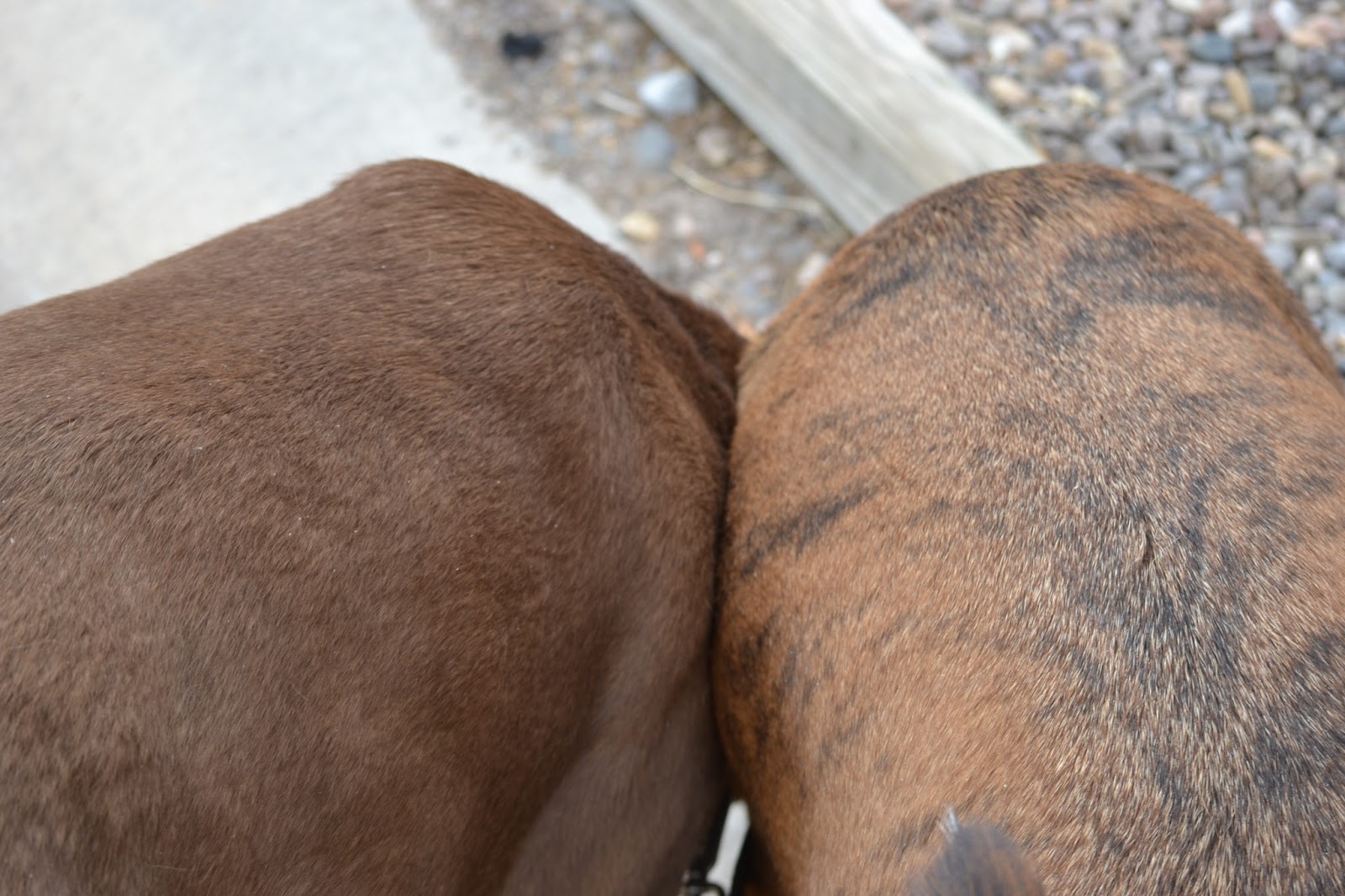
One thing I've noticed about the dogs when they play with their Kongs is they use they paws like hands. It's so cute to watch. Buddy usually just uses his teeth to hold the Kong in place because he has such huge jaws--he's my 95 pound chocolate lab. He's always a gentleman, though, as you can see in the picture below.


Gentleman Bud always crosses his paws when relaxing.

 The other three dogs, though, use their paws to hold their chew toy in place, as you can see in the picture of Chewy below. They love their toys and Chewy the chihuahua's toy is actually a dental chew. Sometimes I take it away from him then give it back to help train him not to be so aggressive.


Chewy holding his favorite toy. 

When I watch him chew I can usually tell when it's time to clip his nails, too, because he uses them to grip his toy. Chewy's toy is also a favorite of the other dogs and they often wait until he falls asleep and try to swipe it. Unfortunately, they have such big jaws that they literally eat Chewy's chew toy, then I have to replace it and they have a belly full of plastic. After losing two chew toys we now wait until Chewy is sleeping and toss his chew toy into the sink for a cleaning. 


Chewy preparing for his morning nap. 

Chewy sleeps in our bed--he literally crawls beneath the covers and sleeps at the bottom of the bed. The big dogs, however, sleep on blankets and I cover them up before bed. Baby's favorite blanket is purple, but he's not always ready for bed when I cover him up. If he hears me in the kitchen fetching water and tea, he will follow me around until I go to bed. His blanket, however, stays on his back and he looks like a purple creeper following me around. It's pretty funny to watch. 


Yes, this is Baby in the purple blanket, 
following me around the house at night as I get ready for bed!

I have mentioned before that I have seen mice climbing the shrub/tree that grows above the wall on the side of our house. I see them on the ground, as well, and thought that they were living in a hole I found in the garden shed. However, I did notice a nest in the shrub, which I thought belonged to a bird. Today, I watched a pair of mice climbing through the shrub, eating the bird seed, and when I came too close for their comfort they easily slid into the nest--apparently, the nest belongs to the mice!


Mouse in the tree.


Mouse eating bird seed.

We had a near disaster today. It is still a bit of a mystery, but the brick wall in back of our house collapsed and after three hours of interviewing neighbors, speaking with the police and photographing the evidence, I suspect we had a freak wind event. A large portion of the wall appears to have been knocked down intact then broke apart when it hit the cement slope behind our home and the bricks fell into the arroyo and broke into pieces. 


The collapsed wall behind our house. 

I walked the dogs around 3 p.m. and photographed some nasty looking clouds, so I knew there would be bad weather. I did not know just how bad it would be, but I suspected we might have rain. The severe winds are supposed to come tomorrow with wind gusts as high as 60 mph.

'

Dark clouds over Sandia Peak.


 I noticed these clouds because they appeared to be three roll clouds, 
indicating fierce winds coming over the mountains. 

I left for the grocery store after feeding the dogs their dinner, but I also left the back door open. It wasn't windy at the time, or cold, and I wanted them to be able to go out if they needed to since they had just finished eating. 

When I returned, as soon as I got out of the truck I noticed roof tiles on our front gravel. I picked them up, seven or eight pieces, and realized they were not from our roof, nor did they appear to be from any of our neighbor's roofs. I thought this was odd, so I stacked them in the garage to show to my husband later. Then I took the new bird seed out back for the birds and noticed a bird feeder broken and on the ground. I also noticed some plants were knocked over. I still wasn't aware there was a problem, though. 

I walked to the far corner of our very large yard and started to clean up as we have an appointment to show the house tomorrow (we are selling the house to move to Colorado so we can be closer to the grandchildren. The dogs followed me. Nothing seemed out of place then suddenly I realized the wall was gone.

The wall collapsed evenly with the sand in the yard, 
so I do not believe someone was pulling the wall over, 
or that it had anything to do with faulty construction. 
It was hit with blunt force from inside the yard. 


At first, I just stood and stared. It seemed so odd--it just wasn't there! Then I realized the dogs were no longer fenced in. Baby, of course, hopped over the bottom row of bricks and started trotting down the street so I had to chase him down. Then I called the police. The police decided it was vandalism, but I couldn't find any signs of vandalism and they agreed that it would have taken great force to pull the wall over. No one could have come into the yard to push it over since the back door was open and the dogs would have chased them out. 


If my dogs had been in the yard or near the fence, they could have fallen into the arroyo with the bricks. If the chihuahua was outside, he would have been killed. 


I then spoke with the neighbors and our real estate agent. One neighbor told me he was at church, but heard horrific winds whipping around the church, some of the worst wind he's heard since moving to New Mexico, and this was around 4 p.m. I was in the grocery store at that time, so I would not have heard the winds. My real estate agent also heard terrible wind sounds about the same time. I also noticed that two sections of bamboo fencing are missing, so they must have blown over someone else's wall and are probably in their yard. One of our neighbors was not home, but their front double doors were wide open and their wind chimes were on the ground. Thank goodness they have strong door screens to keep their dogs inside. This, combined with the plants and the roof tiles have convinced me we were hit with a freak wind, or a gustnado. Possibly even a tornado. 

If the wind was as loud as my friends and neighbors have said, then the dogs would not have gone outside, thank God! They would not have heard the wall collapse over the wind. This possible saved their lives. The police did say they were certain the dogs did not knock the wall down as they would have tumbled into the arroyo and suffered serious injuries, and if they survived they would have been terrified and run away. They were all in the house sleeping when I came home from the store. God was definitely watching after my little creatures today. I will never leave the back door open again when I leave! 


Wednesday, March 13, 2013

Little Birds, Old Dogs, Mrs. Thrasher


Buddy, Holly and Chewy the chihuahua wrestling on my bed-
-yet another way they choose to keep their attractive canine figures. 

Lately, we've been walking our dogs in the neighborhood instead of in the desert. There's a few reasons for this change. First, it's springtime in New Mexico and the coyotes are mating, establishing their dens, moving a bit closer to town for some reason and acting viciously territorial. It's not worth the fight. The second reason is Baby the desert dog has put on a few winter pounds. When we take him to the desert he runs for a bit to find something to chew on, then spends the rest of his time chewing on wood and rolling in the sand. If I take him for a 20 minute walk he stays in shape.


The male little bird.

On our walks we've noticed a flock of birds that seems to follow us. They like our neighbor's trees across the street, but we've noticed they fly from tree to tree and follow us around the block. Perhaps they are curious about the dogs. We haven't figured it out. They are very small birds, smaller than a house sparrow, slightly larger than a hummingbird. I did manage to take some pictures of males and a female, which you can see to the right. I haven't identified them yet. They are a playful bunch and they love to sing. They also stay together in pairs.


I believe this is his mate, 
though it also appears to be a type of finch that could have been nearby.

Speaking of birds, our house is for sale and I will soon be saying goodbye to yet another flock of friends. I think the Thrasher family will be the most difficult birds to say goodbye to as I've grown fond of standing on the back porch and talking to them after the sparrows and finches have moved into the tall threes in the arroyo. I will miss the Thrasher family. There is a male, female, and a juvenile.

Thrashers are in the Cat Bird family, which means they have the ability to mimic the calls of other birds and even the sound of cats. I would assume this ability is a gift they were given to warn other birds of the presence of a predator. I haven't heard our Thrashers meowing, but I have heard them making sounds that are similar to crows. They are fun, and I will miss my old friends.


Mrs. Thrasher and I spend a lot of alone time in the evening.
When the other birds fly off, she sits on the wall, 
waiting for me to come outside and give her a snack.

Speaking of old friends, I have a friend whose old dog, Buddy, is suffering from a degenerative disease. He does not have long to live. Growing old is hard on dogs. They often develop arthritis or other diseases that make it difficult for them to move around, and when you live with an animal from the time they are a pup this can be painful to watch.

I also have a few old friends. Our chocolate labs, Buddy and Holly, are eight years old, which is middle-aged for the breed. However, our twins (they are brother and sister) are also a mixed breed, we believe, or so we were told when we rescued them, and mixed breeds generally live longer. They cuddle and play with each other like puppies and often cross their paws as if they are holding hands.

Buddy and Holly cuddling.

It is sweet to watch them together, they are exceptionally loving animals. Buddy has always shown more compassion toward other creatures than any animal I know. I enjoy taking him for walks because he bounces and prances just like a young pup.

My Buddy

When they were young we lived in Colorado and they loved to play in the snow. Unfortunately, it was often windy where we lived and they could not hear us calling them back to the house, I cannot even tell you how many afternoons I spend driving around our 35 acres searching for them, scared to death they were going to be attacked by coyotes, and they were attacked once! It is a miracle they survived, but they did. They are strong, healthy, beautiful friends.

Buddy and Holly with Baby, the dog we rescued from the desert, sandwiched in-between.  Baby was searching for a pack, a place to belong, and Buddy and Holly were happy to oblige.
They love snuggling on blanket at my feet while I work on the computer. 

I am praying for my friends, and their dog. They have a painful road ahead. Dogs are such a blessing to our lives and it is difficult to say goodbye, which is why I make it a rule to spend time playing affectionately with my animals each day to show them how much I love them and appreciate their presence in my life.

Chewy the chihuahua. 
This is his look that says, "Why did you stop petting me? Is there a problem?" 

Tuesday, February 5, 2013

The Road Runner Fast Food Restaurant in my Backyard

"If you're on the highway and Road Runner goes "beep, beep," 
just step aside or you might end up in a heap!" 

The "Roadrunner Song" was written and sung by Barbara Cameron for a series of Looney Tunes and Merrie Melodies cartoons based on characters created by Animation Director Chuck Jones in 1948 for Warner Bros. A few years have passed since I first watched the Wile E. Coyote try to destroy the Roadrunner with a variety of strange devices purchased from The Acme Corporation, and although modern parents may argue against the amount of violence in the show (and rightly so) I still laugh when I think of this show.

And all these years later, I now have my own version of The Roadrunner Show playing out in my backyard. As I stand near the shed chopping wood, or work on the back porch potting plants, the neighborhood road runner flies over the side gate, trots confidently along the wall behind me, leaps into the air and snatches a tiny sparrow so quickly if you blink, you miss it, then trots to the back wall, flies into the arroyo, and eats his lunch.


He may be sneaky, by he's very photogenic. (All photos by Darla Sue Dollman.) 


This has become a daily occurrence now. We had such a huge baby boom last spring in the community bird shrub on the side of the house that his antics have hardly made a dent in the population. Nevertheless, it is a bit disconcerting to know that my bird feeders, water containers, careful cleanliness and care has set up a fast food restaurant for the neighborhood predator.

I believe he is a male. He is quite colorful, but still young, clearly a juvenile. He is clever, agile, and shockingly fast, with the emphasis on shock--by the time I turn around and set down the ax, he's captured his lunch and disappeared from my yard.


Road Runner perched on the wall and ready to flee.


I first noticed the Roadrunner this past summer when I was having daily garage sales. It was a particularly busy sale and he must have thought it was a barbecue because he was wandering between the shoes of my amused neighbors, jerking his head from side to side as he searched for snacks. Roadrunners are opportunistic eaters, which means they'll eat anything they can find. My husband sold sunglasses from a trailer this past summer and there was a Roadrunner living nearby who always knew when my husband was about to eat lunch because he would suddenly appear at the door of the trailer, begging for scraps of bread. Steve started taking two lunches, one for him and a baggie of snacks for the bird.

Sometimes the circle of life in the animal world can be heartbreaking. I love my song birds. I love the fact that I can hear them chattering in their shrub when I am on the complete opposite end of the house with all windows and doors closed. When my children and grandchildren visited last year my daughter asked how I could possibly stand the noise. As the cliche goes, it is music to my ears. When I walk my dogs through the neighborhood, I can hear my bird shrub a block away.


My sweet, little friends are, unfortunately, Road Runner to-go food. 

Obviously, it is a bit painful to watch the Roadrunner escaping with my little friends, but there is an interesting, albeit morbid, consolation to this situation--death comes quickly from a Roadrunner. They are not only surprisingly fast when they capture their prey, but they immediately smack their victim's head against the ground or brick wall, killing the creature instantly. They literally never know what hits them. I have seen them do this numerous times to lizards. You blink and you miss it.


Road runner's favorite snack food. High in protein, low in sugar. 
I run the healthiest fast food joint in town! 


The Roadrunner is the New Mexico State Bird. There are two species in the Rio Grande Valley, the Greater Roadrunner  (Geococcyx californianus) and Lesser Roadrunner. They belong to the cuckoo family and are also known as the Californian Earth Cuckoo; chaparral cock; ground cuckoo, and "snake killer."

Roadrunners breed in the desert and are seen most often in the American Southwest--California, New Mexico, Arizona, Texas, Nevada, Utah, and Colorado. They can also be found in lesser numbers in Oklahoma, Kansas, Louisiana, Arkansas and Missouri. In Mexico, they live in Baja California, California Sur, Sonora, Chihuahua, and various other places.

The Roadrunner builds its nest out of sticks arranged on a cactus or bush. They lay between three and six eggs, which hatch in 20 days. Chicks fledge, or develop feathers for flight, in 18 days. A Roadrunner couple may have two broods a year.


This is one well-fed Road Runner. (He's looking a bit chubby.)

The Greater Roadrunner is two feet long, and most of that length is its tail. They are wobbly-looking birds with funny legs and thin, pointed beaks, or bills. The upper part of their body is brown with black streaks, though I've seen them with pink spots, too. Their necks are white or light brown with dark brown streaks. They have white bellies. In addition to their speed, they are also known for the crest of brown feathers that stick up on the head and their beauty is in the patch of orange and blue skin behind each eye--very pretty. Sometimes this can be difficult to see when they're running past, but it shows up well in pictures.


Note the colors around the eyes. Beautiful.


I actually had more opportunity to observe their behavior while living in Texas. We had a pair living on our five acres that would bring their young up close to the front picture windows of our house to teach the to hunt. The shrubs near our house were filled with anole lizards, a Roadrunner treat, but they also eat insects, fruit, seeds, snakes, mice, spiders, scorpions,centipedes and millipedes, so they could be considered a beneficial animal, as well. If they are attacking a large snake they will work as a team. It's easy to tell when they spot an animal. The Roadrunner will hold very still for a few moments as if it is taking a rest, then suddenly strike with amazing speed.


Lovely little lizard I photographed at my daughter's house in Colorado. 
We didn't see any Road Runners in the neighborhood. 
Apparently I run the only Road Runner fast food joint. 


I read an article that said "they are capable of weak flight," but the one who lives in our neighborhood gets around very well. In fact, he likes to sit on the neighbor's roof to rate his meal options. As for speed, Roadrunners have been clocked at 26 mph, the fastest running speed every clocked for a flying bird.

The Hopi believe the Roadrunner provides protection against evil spirits, so in that respect, I guess we should consider ourselves blessed. To be honest, I do consider his daily visits as a blessing, in spite of the loss of my tiny friends. Our young Roadrunner friend is also a special creation, a gift from God.


Wednesday, December 26, 2012

Just How Much Can One Little Store Do?


Susana Vasquez and Roberto Holness with Bindi, 
a regular customer at Pet Food Gone Wild. 


There seems to be a problem in New Mexico, a problem with abandoned animals. As the economy continues to worsen, so does the situation for large dogs. They are often abandoned, and in dangerous places, such as the desert where they are prey for roaming packs of coyotes. There is also a law against abandoning animals and the local no-kill shelters are filled with large dogs, dogs that are often considered un-adoptable due to their size and the expense of their care.

Those who care, do what they can. I recently adopted a medium-sized dog that I found in the desert. We have two chocolate labs that we bought from a woman who had ten puppies in a hot truck in a parking lot in Colorado. The next day, the rest of the litter was found abandoned on the side of the road. Our chihuahua was abandoned in the Texas forests and our cat was found in a dumpster 12 years ago. With four rescue dogs and a rescue cat I am at my limit according to city ordinances--five animals. There are so many people in New Mexico, like me, who want to help, but in times like these, how much can one person, one couple...how much can one little store do?

In Rio Rancho, New Mexico there is a tiny pet food store called Pet Food Gone Wild. In addition to selling only natural, organic and holistic dog and cat food, the owner of this store, Susana Vasquez, and her husband,  Roberto Holness, frequently provide foster care for dogs. They also donate dog food to local shelters.

"We actually foster animals through different rescue groups," Roberto explained. "So far, we have fostered animals for the Austin Stripes, New Mexico Dogs to Serve Better, and Eco Pink Weinermeiner Rescue.

"Every month, we also donate 500 lbs a month to different rescue groups, we ask people to nominate different groups on our Facebook page and people vote and the one that gets the most votes gets the food. Once the group gets food they do not participate for 90 days to prevent the same group from winning every time. So far, we have given food to seven groups."

The owners of Pet Food Gone Wild also have two rescue dogs, Lexie, and Leopold. They came up with the idea for the store when they moved to New Mexico from Chicago and realized they would have to drive to Albuquerque to get the quality food they needed for their dogs. Eventually, they realized a need for other services in the area, such as foster care, when they learned more about the situation dogs are facing in New Mexico. They realized they wanted to help in ways other stores don't.


Blue, one of many foster dogs 
who found homes through Pet Food Gone Wild. 


The owners of Pet Food Gone Wild are sometimes asked if they know where people can buy purebred dogs and they firmly tell them no. they do not believe in breeding dogs when there are so many good dogs in New Mexico desperate for homes.

They also urge people to look into more healthy options for their pets, such as healthy foods and healthy diets. "People think it's more expensive, but I tell people you're going to end up spending more money at the vet if you give them lower quality food," Holness explained. "Our goal is to try to better educate people on healthier options for their pets, but we also try to bring a small town feeling to our store with customer service. People bring their pets into their store to meet other dogs and other people." The store also has a dog bath facility in the back, which is very convenient, and they are working on finding a groomer to provide full-time grooming services.


Pet Food Gone Wild
2415 Southern Blvd. SE
Rio Rancho, NM 87124
505/994-0101
petfoodgonewild@gmail.com
www.petfoodgonewild.com

Friday, September 28, 2012

Layla Lou the Bedroom Bunny


Layla Lou the Bedroom Bunny


I have a bunny in my bedroom. She is very sweet, well-behaved, paper-trained, and loves to play. She runs circles around me when I come to see her then climbs on my back to sniff my hair (I think she likes my shampoo) or climbs onto my lap so I can pet her. She loves to rub noses and when I make kissing noises she makes soft kissing noises in return.

Layla Lou has had a rough life. Our neighbors pointed her out to my husband one hot afternoon. They said she'd been underneath our trailer on the side of our house for four days and they were concerned she didn't have much longer to live. I crawled beneath the trailer to take a look. She was covered in mites, her ribs were showing, and she was clearly dehydrated.

I gave her some water and spinach, slowly. When she began to perk up, I gave her an oatmeal bath and sprayed her down with a bug spray from the local pet store. The bugs immediately disappeared. Next, I realized the more pressing problem--there is no home for homeless rabbits in my area, and until I could find her owner, I had to find a place to keep her. With four dogs and a cat in our three bedroom house, this would not be easy. I made her a bed in one of the pet carriers and set it up in the guest bedroom, but she doesn't like it. She prefers to sleep on the bed. I also placed newspapers in the corner and discovered she is house trained--carefully house trained. She has never once had an "accident" off the newspapers in the corner.


Layla Lou lounging on the bed. 


Layla Lou has now been with us two months. No one has answered my many advertisements and postings for a lost rabbit, but deep inside, I knew they wouldn't. I knew when I saw her that she was an abandoned Easter rabbit--parents buy bunnies and chicks for their children for Easter, realize it takes work to care for them, and they abandon them, assuming the animals will be capable of caring for themselves in the wild.

There is a night and day difference between wild and domestic animals, and in this situation, a night-mare. Little Layla Lou was released in a city that has an ordinance against lawns due to repeated droughts. Every house is rockscaped, and it only rains once a year during the Southwest Monsoons. I suspect that if we hadn't found her beneath the trailer, she would have been dead within a few days, either from starvation and dehydration, or one of the packs of coyotes that I listen to each night as they roam our city streets.


Layla Lou preparing to hop onto the bed.

We will be moving back to Colorado soon, and when we do, little Layla Lou will have a home of her own--I am working on building one now with scraps of wood, but it is challenging because rabbits chew wood to keep their teeth sharpened. In fact, I buy little packs of wood sticks for her to chew on. These are her toys. If I try to pick one up she makes a growling noise and charges toward me as if she is trying to protect her toy, then I pet her nose and she closes her eyes as if to say, "just kidding. I still love you."

When we come into the room, Layla Lou runs circles around our feet. I sit on the bed and she climbs up my back with her front paws--she likes to sniff my hair--then climbs onto my lap so I can pet her. I lay my palm flat across her nose and slowly move it over her face and ears as she falls asleep. I do this three or four times a day--she's a bit spoiled.

Oddly enough, Chewy the chihuahua and Layla Lou have decided they like each other. Chewy snuck into the room once when I had my hands full of Layla's water and food dish. Chewy sits beside me while I pet Layla Lou. Sometimes they sniff each other's noses. Sometimes Layla runs around the room and Chewy runs from one side of the bed to the other, not chasing her, just watching her run. He does not bark or growl, he just watches. Maybe some day they will learn how to play with each other, but until that time I still keep my fingers wrapped in his collar when they are close together--just in case. I don't know that it's really necessary. Layla Lou is fully recovered now. She is fat and sassy, bold and assertive.


Layla Lou and Chewy the Chihuahua touching noses. 

This is a bit of a surprise to me because rabbits are prey to all creatures. They cannot defend themselves in any way. Their mouths are beneath their head and very small. Their claws are small. The bulk of their body is completely vulnerable and exposed. It is as if God made them to keep other animals alive. I believe this is why God has brought this rabbit to me. I am disabled. I, too, am vulnerable, exposed, and find it difficult to protect myself. I believe God brought Layla Lou into my life for a reason, to remind me that I must be cautious, protective, and yet bold and assertive. Layla reminds me that even when the situation seems dire, and it seems as if I can't possibly go on, there is always hope. There will always be someone willing to slide a bowl of water beneath the trailer as I shiver in fear, someone to offer me food, shelter, safety, and love, enough to get me by until I am strong again. 

Monday, August 27, 2012

"Know that the same spark of life that is within you is within all of our animal friends, the desire to live is the same within all of us." --Rai Aren, 'Secrets of the Sands'